
Peering inside 3D-printed steel: Paving the way for stronger, safer aerospace and automotive components
University of Toronto researchers use synchrotron light to study microscopic defects left by current process
By Greg BaskyIn the past when companies that build airplanes, spaceships or cars wanted to update the design of a specific part, they’d have to create a new die or mold for casting that specific component, a process that’s expensive and could take days if not weeks. And if the part didn’t fit quite right, they’d have to continue making new dies until they got the issue sorted out.
Now the aerospace and automotive industries are using 3D printing for this iterative R & D process, which is called rapid prototyping. One of the techniques is called laser powder bed fusion: a thin layer of ultrafine powder is spread on a plate, then a powerful laser traces the shape of the steel part at that layer, melting and fusing together the powder particles. These steps are repeated over and over again, layer upon layer, until the part is complete. If each layer is 100 microns thick, a single part might contain tens of thousands of layers.
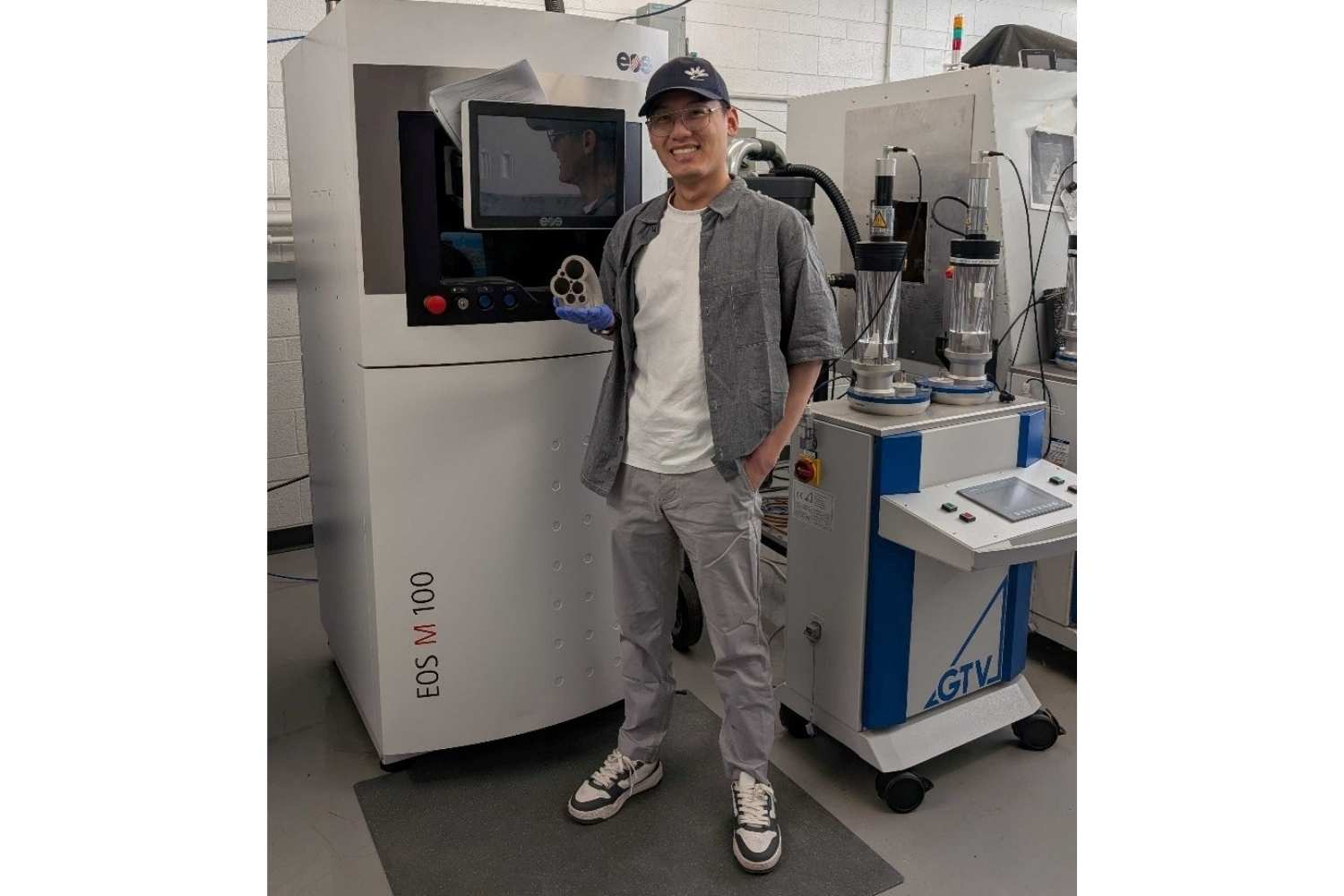
This new method is faster and costs far less than traditional die casting. A major downside though is that the rapid heating and solidifying process can “build in” invisible defects -- called residual stress -- which could affect the mechanical properties of a part and ultimately cause it to fail. People working in the industry are aware of the issue and can adjust their “printer settings” accordingly, but it’s not well understood where specifically these defects occur.
Researchers from the University of Toronto (Dept of Materials Science and Engineering) used the Canadian Light Source at the University of Saskatchewan to peer inside samples of 3D printed steel to learn more about where it occurs. The distribution is not uniform, so some areas in an object have more residual stress than others.
Using ultrabright synchrotron light enabled them to localize the residual stress with precision down to about 2 microns – without having to cut into the steel. For reference, a human hair is between 50 and 70 microns in diameter.
“We were able to make a map of the residual stress,” says Tianyi Lyu, who conducted the study as part of his PhD under Professor Yu Zou, Canada Research Chair in Materials and Manufacturing for Extreme Environments. He believes they were pioneers in using a classic X-ray technique – called Laue diffraction -- to study residual stress in metal 3D printing.
The team’s top finding is that most residual stress is located at the edges of where the laser makes its pass while melting the steel powder; the most defects tend to occur at spots along the edges, sandwiched between two laser paths.
“This means we should not be using the same pass on each layer because this is causing an accumulation of residual stress,” says Lyu. “Rather, when doing the printing, we should change the process parameters (settings) such as for each layer to minimize this build up of stress.”
Lyu says that based on what they’ve learned, they now want to explore whether they can identify the optimal “printer settings” to make the distribution of defects more uniform. “This would be a big if, but if we can control where the residual stress occurs can we take advantage of that? If we have residual stress with a specific distribution, could it enhance the mechanical properties of a material instead of making it weaker?”
That breakthrough could eventually lead to stronger, safer components for spacecraft, airplanes, and cars.
--
Lyu, Tianyi, Changjun Cheng, Lizhong Lang, Renfei Feng, and Yu Zou. "Mapping microscopic residual strain heterogeneity in additive manufactured 316L stainless steel by micro-Laue diffraction." Scripta Materialia (2026): 117364. https://doi.org/10.1016/j.scriptamat.2026.117364