
Makar
A look into the effects of sulfide mineral impurities of coarse concrete aggregates in the long-term stability of concrete.
May 2021
2020 was a challenging year shared by many due to the global pandemic, but it was already going to be a challeging year for the Industry Services group. The primary revenue-generating beamline for the Industry Servies group, CMCF-ID, started a major upgrade, which is currently scheduled to be complete in June 2021, after some delays attributed to the pandemic.
There are several exciting initiatives that the Industry team will be involved with in 2021. The Industry group will host a post-doctoral fellow in the coming year working on a project entitled "In-Situ X-Ray Imaging of Carbon Fibre Composite Manufacturing Processes"; this work will be on the BMIT beamline.
The Industry Services team is currently partnering with PSI Technologies and PSI Mining to investigate molecular scale processes associated with using recycled products. This mechanistic understanding will then be applied to develop models for real-world applications. Another project related to materials infrastructure is discussed in more detail below.
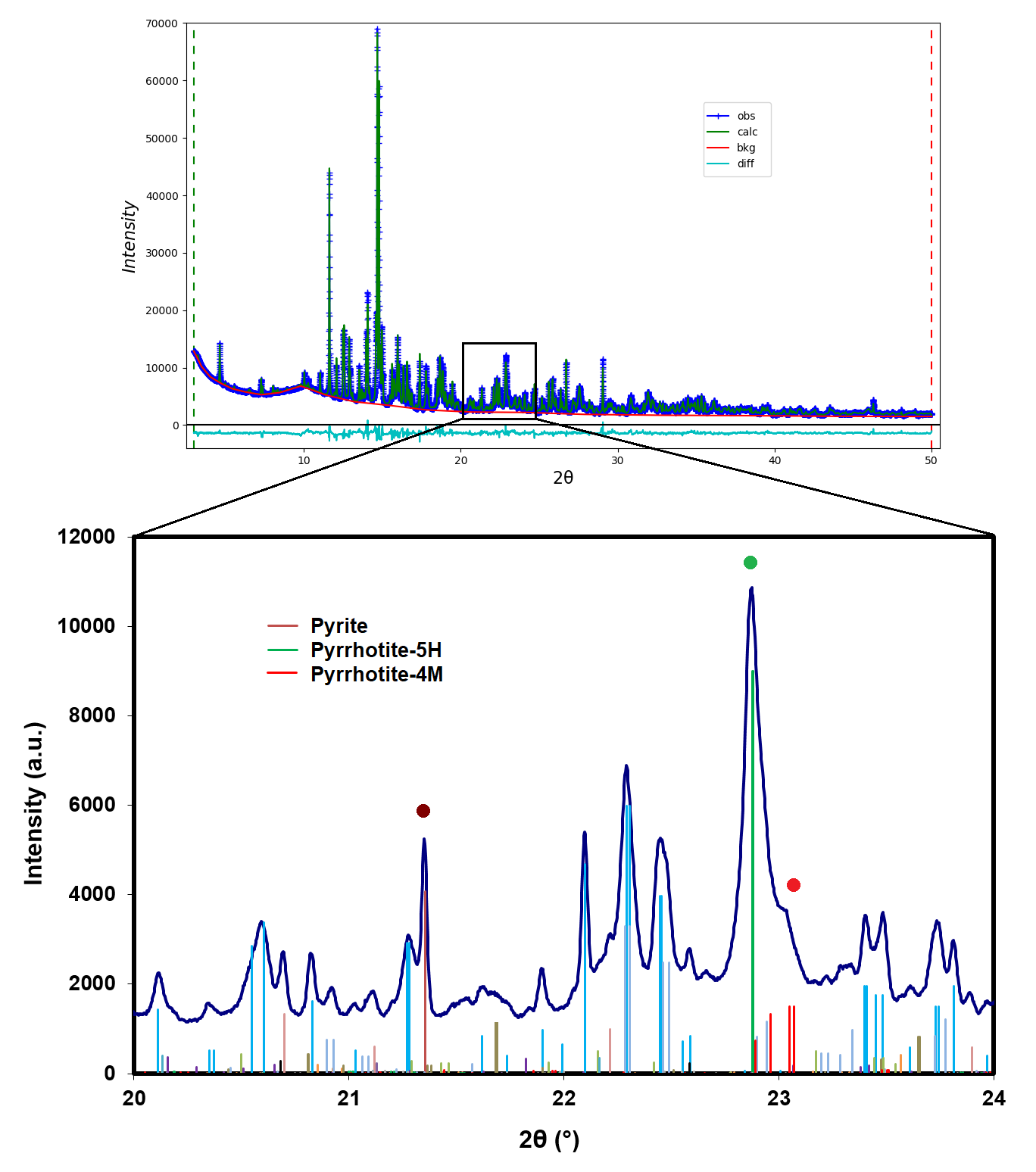
In collaboration with NRC staff members, Jon Makar, and Rana Masoudi, the CLS has investigated high resolution measurements on pyrite (FeS2) and pyrrhotite (Fe1-xS) in coarse concrete aggregate. Concrete aggregates are granular materials with sizes of 5-20 mm and controlled composition, which when combined with water and cement form concrete. Trace reactive sulfide mineral impurities, like pyrrhotite and pyrite, in aggregate can have a major deleterious impact on the long term structural integrity of the final concrete product. Iron sulfides are susceptible to oxidation over time, creating sulfuric acid and ferrous irons [1], which initiate secondary reactions that can cause expansion, cracking, and ultimately, concrete failure. In Canada, concrete failures due to sulfide oxidation have been a prominent problem in Trois-Rivieres, Quebec, and similar concrete issues are a widespread phenomenon with occurences in Conneticut (U.S.), southwest England, and Scandinavia, among other places [2].
Pyrrhotite is sufficiently reactive that concentrations on the order of tenths of a percent are sufficient to cause concrete damage [3]. Therefore, sensitive analytical techniques are required to detect and quantify pyrrhotite and pyrite content in aggregate materials. Synchrotron powder X-ray diffraction (PXRD) has been conducted at the CLS on concrete aggregate materials using both the CMCF-BM and BXDS-WLE beamlines, with quantification performed using Rietveld refinement. Even in complicated aggregate matrices with 10 to 16 different mineral phases present, pyrite and multiple polymorphs of pyrrhotite have been detected and quantified at levels below 0.5 w.t.%. This work will contribute to improved understanding of the distribution and range of sulfide impurities in aggregate materials, and assist with development of additional enhanced techniques for the detection and quantification of trace sulfide impurities [3].
- Belzile, N., Chen, Y.-W., Cai, M.-F., and Li, Y. 'A review on pyrrhotite oxidation,' J. Geochem. Exploration 84 (2004) 65-76.
- Nordic Concrete Federation. 'Impact of sulphide minerals (pyrrhotite) in concrete aggregate on concrete behaviour,' Workshop Proceedings No. 14; Oslo, Norway, November 15-16, 2018.
- Makar, J., Reid, J., Ridsdale, A., and Masoudi, R. 'High resolution measurements of pyrrhotite and other minerals in coarse concrete aggregate,' Presented at the 56th Annual Meeting of the Northeastern Section, Geological Society of America, March 14, 2021.